
Showing posts with label Historical. Show all posts
Showing posts with label Historical. Show all posts
Monday, November 9, 2015
kissinger the war criminal.
For those of you like me who don't know a whole lot about Henry Kissinger, here is a little background: Henry A. Kissinger was sworn in on September 22, 1973, as the 56th Secretary of State, a position he held until January 20, 1977. He also served as Assistant to the President for National Security Affairs from January 20, 1969, until November 3, 1975. Serving in the times of Nixon and Ford. Kissinger is currently alive and well, and still being relevant, according to historian Greg Grandin and his new book titled Kissinger's Shadow, which is an analysis of Henry Kissinger's diplomatic career and post career influence on foreign policy. Or BAD influence, as Grandin is definitely not Kissinger's biggest fan. He goes into great detail explain why he's as responsible for Iraq and the Middle East as Vietnam. The book is well researched, but still an interpretation. Compelling, but still an interpretation. Factual, but still an interpretation. I think a lot of you will find it interesting, but you'll have to decide if it's the right read for you because it's definitely an acquired taste.


Thursday, September 10, 2015
the golden age of spain.
If all history books read like narratives as well as Robert Goodwin's Spain: The Centre of the World 1519-1682 did, history class would be significantly more interesting. It was as if I was reading a novel, and I love novels.

At the beginning of the modern era, Spain became the centre of the western world by accident. And so began Spain's golden age, and Goodwin's tale of how gold and silver got the country out of debt and into the number spot in the 16th century. Universities expanded, the crown got stronger, and opportunities exploded. Despite that pesky Inquisition, it was a beautiful time for Spain and I was happy to learn about all of the good that happened in the country during that time.

At the beginning of the modern era, Spain became the centre of the western world by accident. And so began Spain's golden age, and Goodwin's tale of how gold and silver got the country out of debt and into the number spot in the 16th century. Universities expanded, the crown got stronger, and opportunities exploded. Despite that pesky Inquisition, it was a beautiful time for Spain and I was happy to learn about all of the good that happened in the country during that time.
Wednesday, July 8, 2015
jaw-dropping.
Ever wonder what happened after the Brown v. Board of Education decision when one Virginia school system refused to integrate? Well, I didn't either until I discovered Something Must be Done About Prince Edward County: A Family, A Virginia Town, a Civil Rights Battle by journalist Kristen Green, the TRUE account of the aftermath of this important event in our country's history.

Green, who grew up in the same town, and gives readers a personal look into her own life, as well as a behind the scenes look into Prince Edward County, Virginia, it's black citizens, and all the racism and corruption in between. All of us remember her small town's resistance to change, but many don't know that they went to such extremes. Closing all public schools in order to stop integration. Opening private white-only schools. So much light was shed in this extremely interesting read.

Green, who grew up in the same town, and gives readers a personal look into her own life, as well as a behind the scenes look into Prince Edward County, Virginia, it's black citizens, and all the racism and corruption in between. All of us remember her small town's resistance to change, but many don't know that they went to such extremes. Closing all public schools in order to stop integration. Opening private white-only schools. So much light was shed in this extremely interesting read.
Wednesday, June 24, 2015
history is written through the eyes of the author.
Philosopher Roman Krznaric believes that the future of the art of living can be found by gazing into the past in his book (now in paperback) titled How Should We Live: Great Ideas from the Past for Everyday Life, and I don't disagree.

Krznaric takes readers back in time and covers twelve major issues of life to help us live better. To St. Valentine to teach us the art of loving. To St. Frances to teach the art of family. He's not really asking us to live like these Saints, or the Greeks, or the Aztecs or any of the other historical figures mentioned throughout the chapters, not really. He's asking us to empathize with each other, and to consider doing things slower and more simply.

Krznaric takes readers back in time and covers twelve major issues of life to help us live better. To St. Valentine to teach us the art of loving. To St. Frances to teach the art of family. He's not really asking us to live like these Saints, or the Greeks, or the Aztecs or any of the other historical figures mentioned throughout the chapters, not really. He's asking us to empathize with each other, and to consider doing things slower and more simply.
Thursday, June 4, 2015
railfans.
Tourist Trains Guidebook has come out with a fifth edition (adding to their previous collections) that includes 500 depots, historic sights, excursions, dinner trains, and museums that you must see and do (if you like that sort of thing) with your family, with your lover, with yourself, all over America and Canada so you are bound to find one near you. Magazine Editors of Trains have included full-page reviews of the must-visit hot spots, when to go, what's good to know, what you don't want to miss, and how to get there.

Sign me up for any and all wine trains, please. Yes, they do exist.

Sign me up for any and all wine trains, please. Yes, they do exist.
Monday, May 25, 2015
behind every great man...
Abraham Lincoln is in my family tree. Don't be jealous, I bet if you looked far enough back you will find someone cool in your family tree as well. But since we are basically cousins, I have a soft spot for any historical books based on Lincoln, the latest being, Lincoln's Boys: John Hay, John Nicolay, and the War for Lincoln's Image by Joshua Zeitz.
 For those of you (like me) who are not super familiar with John Hay and John George Nicolay, the first part of the book will catch you up on their lives. Their youth is written separately, they were both writers and they came to become part of Lincoln’s inner circle after his election in 1860 as his official secretaries. Honestly, this book is more about Hay and Nicolay than President Lincoln himself, which works because they were the closest people to him other than his family. They helped shaped Lincoln into the kind of president he was. The kind of president who was remembered so fondly. They were kind of like Lincoln's Olivia Pope. And continued to support his memory after his death. Zeitz created a readable and engaging bio that I found very enjoyable to read.


I was able to visit the Lincoln Monument for the very first time in DC a few weekends ago. It was extremely cool being in our nation's capital. Especially so close to Memorial Day. So much history.
Tuesday, May 12, 2015
upstate new york food crawl.
Beef on weck. Buffalo wings. Upstate New York has some of the best food around. You can't get better pizza logs anywhere else, I assure you. And don't even get me started on Dibella's subs. A Taste of Upstate New York: The People and the Stories Behind 40 Food Favorites by Chuck D'Imperio gives background on the very best food created in the upstate area and is sure to be a huge hit for yourself, your coffee table, or anyone you know who loves to eat and travel. I mean, Saratoga Springs created the potato chip. THE POTATO CHIP! We are making magic up here.

From the Syracuse salt potato to the St. Lawrence Seaway Thousand Island dressing. Learn the history behind the people and places who created this iconic food that our chicken barbecue's would be sad without.

From the Syracuse salt potato to the St. Lawrence Seaway Thousand Island dressing. Learn the history behind the people and places who created this iconic food that our chicken barbecue's would be sad without.
Monday, November 17, 2014
the art of the english murder.
I have gotten pretty into the new TV series, Forever that revolves around an English Medical Examiner who has been alive since the early 1800's because when he dies, he doesn't actually die. He turns up, stark naked, in the Hudson River. Anyways, he used to be a doctor a hundred or so years ago and now he helps solve murders because being alive for so long makes you seriously smart. A Jack the Ripper type episode aired a few weeks ago....which leads me to my next review...

The English (and Americans, okay everybody really) have always had a fascination with crime. The more dark and twisted, the better. The Art of the English Murder: From Jack the Ripper and Sherlock Holmes to Agatha Christie and Alfred Hitchcock by Lucy Worsley retells the stories of famous murders, trials, and horrid creatures who have turned into legends for their crimes. Worsley is quite the storyteller and historian, covering the letter of the law before police forces were created in England, and so on. This book includes both fact and fiction, murder in real life and in literature, and murder based on literature so vividly, you'll forget which is which.
The English (and Americans, okay everybody really) have always had a fascination with crime. The more dark and twisted, the better. The Art of the English Murder: From Jack the Ripper and Sherlock Holmes to Agatha Christie and Alfred Hitchcock by Lucy Worsley retells the stories of famous murders, trials, and horrid creatures who have turned into legends for their crimes. Worsley is quite the storyteller and historian, covering the letter of the law before police forces were created in England, and so on. This book includes both fact and fiction, murder in real life and in literature, and murder based on literature so vividly, you'll forget which is which.
Tuesday, September 30, 2014
1914 history.
Touching again on the 100th anniversary of WWI, I was sent a very unusual account of a soldier's time spent during the first world war in the form of a graphic novel titled Line of Fire: Diary of an Unknown Soldier. The diary includes the first months of the war that everyone thought would be over by Christmas, yet lasted 4 years killing millions. No one has any idea who the author is, what happened to him, or why he stopped writing, although we can imagine. The graphic novel part isn't even the strangest part of this book, the strangest part is that its illustrator Barroux, found a diary on an ordinary day, walking the streets of Paris, in the trash. He scooped it up, created some drawings to go along with the writing, and now we have a truly unique piece of history to enjoy.

Thursday, September 18, 2014
from the mouth of nixon.
In a nutshell, The Nixon Tapes: 1971-1972 transcribes Nixon's most interesting and influential year as president of the United States from the actual tapes that recorded him and his staff in office during that time period. Historical experts, Douglas Brinkley and Luke A. Nichter have been through all the tapes, plucked out the important stuff (well, the stuff they found important for the sake of this particular book) and edited it in a way that readers can easily follow. There is much on the tapes that made Nixon look bad, but I enjoy that the authors decided to show his intelligence as well. I mean, he was super jealous and extremely paranoid, but he was also pretty fricken brilliant. Although the authors do not focus on Watergate, they do focus much of the book on foreign relations, which may either make or break your interest in picking up a copy.

Wednesday, July 9, 2014
the real saving private ryan.
The 70th anniversary of the allied invasion of Europe aka the longest day ever was June 6th, so I thought I'd get in the game and review The Dead and Those About to Die: D-Day: The Big Red One at Omaha Beach by John C. McManus, today. This book focuses on the 1st Infantry Division (The Big Red One) and the crazy slaughter at Omaha Beach. McManus does an excellent job capturing the horrors of war, I still have a stomachache. But it was super exciting to read about the overview of the plan, the level of detail and logistics, the training that went into making this one day successful, and also how close the German's came to derailing the allies plan altogether. Phew. Even those of you who are super nerdy history buffs will learn some new information on what this invasion accomplished and some of the lessons learned that day.

Tuesday, June 10, 2014
so many piggy banks.
America's Fiscal Constitution: Its Triumph and Collapse by Bill White is a must read for anyone invested in the U.S. government. I'm talking voters, politicians, tax-payers...so pretty much everybody. We didn't just become a nation of severe debt overnight. There is a history behind it, and White tells about our past in foreign policy and political agendas in such an engaging way, even I wasn't bored, and that says a lot as I have the attention span of a small child. White begins at the beginning. Once his introduction is complete, he jumps into the narrative, starting with the Founding Fathers being unable to pay the bill for George Washington's retirement party for four months because the pre-Constitutional Convention federal government was so broke. Hmm, it's all starting to make sense now. We were never good at this.

White also shared his own theories on the subject. One theory being that raising taxes will not reduce deficits, so if the government were to cut taxes, it will fuel economic growth and energize the nation's economy. I choose that one.
White also shared his own theories on the subject. One theory being that raising taxes will not reduce deficits, so if the government were to cut taxes, it will fuel economic growth and energize the nation's economy. I choose that one.
Thursday, May 22, 2014
american literary history that you haven't read yet.
Some of you may not have heard of "The Bohemian" movement in San Francisco in the 1860's that produced some of the most important authors in American history. Ben Tarnoff paints a vivid picture of this era and the early writing careers of authors such as Mark Twain, Bret Harte, Ina Coolbrith and Charles Warren Stoddard in The Bohemians: Mark Twain and the San Francisco Writers Who Reinvented American Literature.
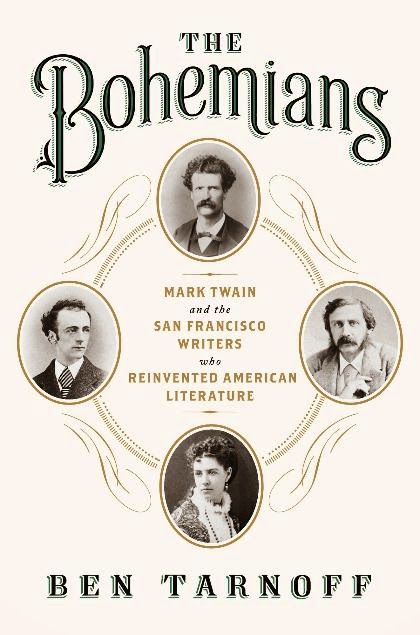
This book is a bit of a bio of these four authors, but it's also a profile of the city of San Francisco and touches on the country's struggle after the Civil War. As you can imagine, many pages are devoted to Twain because of his eventual worldwide fame. But let me tell you, it's not always pleasant. Readers gets some major insight into how much an ass Twain actually was. As much as I like reading about Twain's dirty laundry, the best part of this book was each author's journey to a new style of writing and the detailed accounts of this city in this time period. It's as if San Francisco is Tarnoff's fifth main character.
This book is a bit of a bio of these four authors, but it's also a profile of the city of San Francisco and touches on the country's struggle after the Civil War. As you can imagine, many pages are devoted to Twain because of his eventual worldwide fame. But let me tell you, it's not always pleasant. Readers gets some major insight into how much an ass Twain actually was. As much as I like reading about Twain's dirty laundry, the best part of this book was each author's journey to a new style of writing and the detailed accounts of this city in this time period. It's as if San Francisco is Tarnoff's fifth main character.
Monday, April 7, 2014
shattering some myths.
African Americans have always had a sort of attachment to firearms. I understand that this may sound racist to you at this specific moment, but just wait until you read the book I'm reviewing, you'll realize that my statement was super scholarly.
In his well-researched book, Negroes and the Gun: The Black Tradition of Arms, law professor and author Nicholas Johnson shows us the importance and cost of self defense as he takes us back in time, chronicling the use of arms by Black people throughout US history, especially in the South.

Black people and guns have been getting a bad rap for decades. Johnson documents, time after, time how enslaved Africans and fugitive Africans would fight their way to freedom with guns. How they had an underground market to buy, and or steal these guns. How these guns and their willingness to use them allowed many enslaved Africans to get to Free States. The history of the fight against slavery and the civil rights struggle has been modified and right of self-defense, political violence has been minimized. We live in a time where everyone can agree that enslaving people was completely disgusting and wrong, so did it take Professor Johnson to really open our eyes to the Black perspective in history as well as today? Johnson doesn't condone street violence in Black communities, he gives a compelling argument for the right to own arms by law abiding citizens.
In his well-researched book, Negroes and the Gun: The Black Tradition of Arms, law professor and author Nicholas Johnson shows us the importance and cost of self defense as he takes us back in time, chronicling the use of arms by Black people throughout US history, especially in the South.
Black people and guns have been getting a bad rap for decades. Johnson documents, time after, time how enslaved Africans and fugitive Africans would fight their way to freedom with guns. How they had an underground market to buy, and or steal these guns. How these guns and their willingness to use them allowed many enslaved Africans to get to Free States. The history of the fight against slavery and the civil rights struggle has been modified and right of self-defense, political violence has been minimized. We live in a time where everyone can agree that enslaving people was completely disgusting and wrong, so did it take Professor Johnson to really open our eyes to the Black perspective in history as well as today? Johnson doesn't condone street violence in Black communities, he gives a compelling argument for the right to own arms by law abiding citizens.
Friday, March 28, 2014
a great president who you probably forgot about.
Author Amity Shlaes sets the record straight regarding President Calvin Coolidge and his not so positive reputation in her biography appropriately titled, Coolidge. For those of you who did not pay attention in history class, Calvin Coolidge was the thirtieth president of the United States and served during the 1920's, ending his term in 1929, just as the Great Depression was beginning. Coolidge was a quiet man, and people judged him for it. However, he worked behind the scenes to reduce federal debt and income taxes which favored
middle class growth. Shlaes is adamant in her opinion that Coolidge was not responsible for the Depression, including statistics proving that the blame lay in the later presidents who prolonged the economic decline.

Apparently Coolidge is most remembered for being cold and lazy, probably because he didn't babble on about everything he was planning on doing on live television, interrupting people's favorite television shows. I for one, would have appreciated him. There are some strong points of view, but I honestly believe that Shlaes has given us the most well-researched biography of Coolidge that anyone has ever read.
Apparently Coolidge is most remembered for being cold and lazy, probably because he didn't babble on about everything he was planning on doing on live television, interrupting people's favorite television shows. I for one, would have appreciated him. There are some strong points of view, but I honestly believe that Shlaes has given us the most well-researched biography of Coolidge that anyone has ever read.
Win a FREE copy of Coolidge!
Contest Rules:
1. Follow this blog :)
2. E-mail your name and this book title to: jenileerose@yahoo.com to enter!
3. Contest ends 4/5!
Monday, March 10, 2014
what an adventure.
It never really occurred to me how other European countries, like Italy, were affected by the destruction of WWII until I read Saving Italy: The Race to Rescue a Nation's Treasures from the Nazis by Robert M. Edsel. I mean, the happenings in Italy during this time period, especially in Naples, Milan, Florence and Monte Cassino are unknown to the average person, which is why Edsel's follow up to his previous book Monument Men is such a crowd pleaser with every reader, historian or not. Saving Italy is a true account of the allied effort to save valuable artwork in Italy from
being destroyed in battle or seized by the Nazi's. Seriously, how greedy can a group of people be? Jeesh. Anyways, in May of 1944 an American artist named Deane Keller and scholar named Fred Hartt set off to track billions of dollars in missing Michelangelo's, Donatello's and other ninja turtles, I mean famous artist's work from history. They literally risk their lives to steal back what was stolen, and Edsel tells the story in such a suspenseful way that you'll be on edge until the very last page.

Thursday, March 6, 2014
a children's historical narrative.
The Story of Mankind by Hendrick Willem van Loon was written in 1921 as a way of sharing human history with his grandchildren. Back in December, Robert Sullivan updated and reintroduced this extremely readable resource of world history. And as the title states, this is the literal story of mankind, beginning with the earliest stages of earth and man's earliest ancestors and ending it's 800 pages with a chapter on friendships and communication.

The Story of Mankind is a classic and its length might appear daunting to your 11-14 year old child at first glance. But flipping through the pages with their layman's terms and illustrations will take much of the dullness out of the history of humanity for this overly stimulated generation.
The Story of Mankind is a classic and its length might appear daunting to your 11-14 year old child at first glance. But flipping through the pages with their layman's terms and illustrations will take much of the dullness out of the history of humanity for this overly stimulated generation.
Monday, January 27, 2014
the queen nobody knows about.
Alison Weir’s biography on Queen Elizabeth of
York titled Elizabeth of York: A Tudor
Queen and Her World is actually quite good considering there hasn’t been
much written on this woman’s life, thus not much to go on. There were a few
more “may have’s” than I would have liked, leading me to believe that no one
really knows exactly who this queen was, but really how well do we know anyone
from the past?

Personally, I enjoy how Elizabeth of York reads like a Life & Style magazine article
about the Queen, her children, husband, and the times they lived in. Some
historians may not enjoy the abundance of details and Weir’s literary writing
style, making this history lesson much less of a bore, but I appreciate it!
Win a FREE copy of Elizabeth of York!
Contest Rules:
1. Follow this blog :)
2. E-mail your name and this book title to: jenileerose@yahoo.com to enter!
3. Contest ends 2/5!
Friday, December 20, 2013
MIA in WWII.
Vanished:
The Sixty Year Search for the Missing Men of WWII
is an excellent account of Dr. Pat Scannon’s search for the lost soldiers of
the Pacific Theater. This plane and crew was pronounced MIA during the World
War II battle in the Pacific, and never heard from again. Although Scannon
first got involved purely due to obsession with finding answers, it soon became
about providing closure for the family members.

Author Wil S. Hylton has expertly combined the
stories of the missing men, their families and friends left behind, the history
of the time period, AND the modern day search to find what vanished so long ago.
Impeccable research, and putting together the pieces of the lives that were
lost, I’ve never read anything like it.
Friday, December 13, 2013
required reading for politicians.
Authors Daron Acemoglu and James A. Robinson are
here to explain why some nations are prosperous and others not in their
economic resource titled Why Nations
Fail. These two have spent 15 years collaboratively studying many nations
around the world, and with their collective research have drawn some
interesting conclusions. I thought the very first example touched on was particularly
interesting regarding Nogales which borders the US and Mexico. The observation
is made that the wealth on one side of the border is very different from the
other despite the populations having the same ancestry. The facts are told in a
narrative voice rather than in graph/chart form which I personally enjoyed. But
I know that many of you economists out there prefer your charts so that you can
get your information quickly. There is a lot of history in this book, which
could bore some of you who are just looking for the answers, but if you have
some time, I suggest picking up a copy.

Subscribe to:
Posts (Atom)